Dental Implants vs Dental Bridges: Which Is Better for Replacing Missing Teeth?
Missing a tooth can affect more than just your smile. It may make chewing difficult, affect nearby teeth and disturb the way your bite functions.
Two common options for replacing missing teeth are dental implants and dental bridges. Both can restore the appearance and function of your teeth, but they work differently.
What Is a Dental Implant?
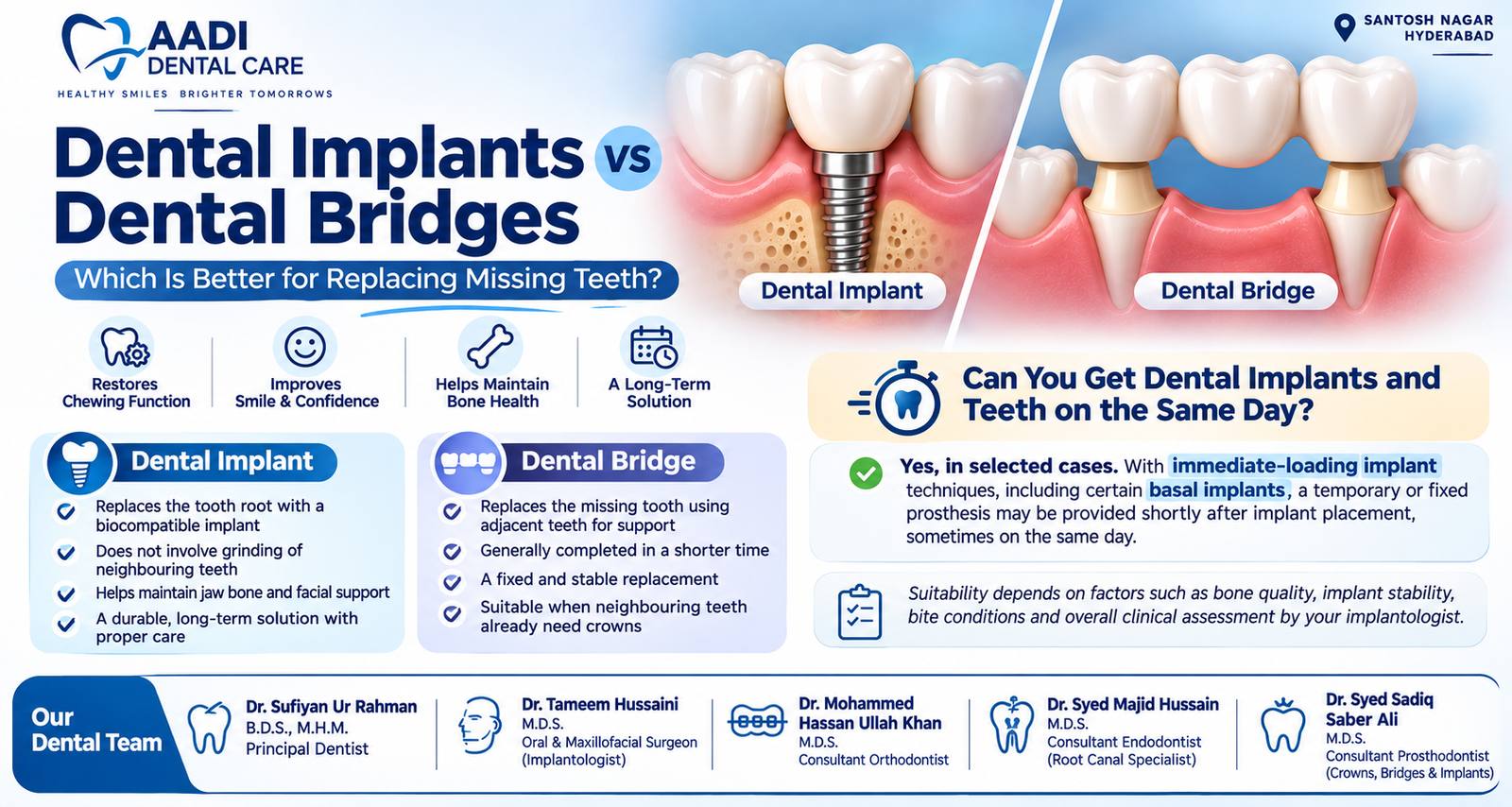
A dental implant is a small biocompatible post, usually made of titanium, placed into the jawbone to replace the root of a missing tooth. Once the implant is stable and the treatment plan allows, a dental crown is attached to restore the appearance and function of the tooth.
Advantages of dental implants:
Do not generally require grinding down neighboring healthy teeth.
Provide good stability while chewing.
Help maintain the bone around the implant.
Offer a durable, long-term tooth replacement option with proper care.
What Is a Dental Bridge?
A dental bridge replaces a missing tooth by using the teeth on either side of the gap for support. These supporting teeth are prepared to hold crowns connected to an artificial tooth.
Advantages of dental bridges:
Usually completed in a shorter time.
Do not require implant surgery.
Can be suitable when neighbouring teeth already need crowns.
Provide a fixed replacement for the missing tooth.
Dental Implant vs Dental Bridge: Key Differences
1. Treatment Procedure
Implants involve placing a post into the jawbone, whereas conventional dental bridges rely on neighbouring teeth for support.
2. Treatment Time
Traditional dental implants generally require a healing period before the final crown can be placed. However, selected patients may be suitable for immediate-loading implant techniques, including certain basal implant approaches, where a temporary or fixed prosthesis can be provided shortly after implant placement, sometimes on the same day.
The suitability of immediate loading depends on bone quality, implant stability, bite forces and the overall clinical condition.
Dental bridges are generally completed in a shorter treatment period.
3. Effect on Neighbouring Teeth
Dental implants usually leave adjacent healthy teeth untouched. Conventional bridges require preparation of the supporting teeth to accommodate crowns.
4. Bone Health
Dental implants transfer chewing forces to the jawbone and may help maintain bone around the implant. Dental bridges replace the visible tooth but do not replace its root, so bone loss in the missing tooth area may continue.
5. Maintenance
Both options require regular brushing, cleaning and dental check-ups. Dental bridges need additional attention to clean underneath the artificial tooth, while implants require careful cleaning around the implant and crown.
Can You Get Dental Implants and Teeth on the Same Day?
Yes, in selected cases.
With immediate-loading implant techniques, including certain basal implant approaches, a temporary or fixed prosthesis may be provided shortly after implant placement, sometimes on the same day.
However, immediate loading is not suitable for every patient. Factors such as bone quality, implant stability, bite conditions, the number and position of missing teeth and overall oral health must be carefully evaluated.
Your implantologist will determine whether conventional implants or an immediate-loading approach is more appropriate for your case.
Which Option Is Better for You?
There is no single answer for everyone.
Dental implants may be suitable if you have adequate bone support, healthy gums and are looking for an option that does not depend on neighbouring teeth.
Dental bridges may be a suitable alternative when neighbouring teeth already require crowns, implant surgery is not preferred or other clinical factors make a bridge more appropriate.
Your dentist will evaluate your oral health, bone condition, neighbouring teeth and overall treatment requirements before recommending an option. Dental X-rays or a CBCT scan may be advised when necessary.
Replace Your Missing Tooth with the Right Treatment
At Aadi Dental Care, Santosh Nagar, Hyderabad, patients have access to implant and prosthodontic expertise to help them choose an appropriate tooth replacement option.
Our dental team includes:
Dr. Sufiyan Ur Rahman, BDS, MHM – Principal Dentist
Dr. Tameem Hussaini, MDS – Oral & Maxillofacial Surgeon and Implantologist
Dr. Mohammed Hassan Ullah Khan, MDS – Consultant Orthodontist
Dr. Syed Majid Hussain, MDS – Consultant Endodontist
Dr. Syed Sadiq Saber Ali, MDS – Consultant Prosthodontist
The appropriate specialist will evaluate your condition and guide you towards a suitable treatment plan.
Book a consultation at Aadi Dental Care to explore the right solution for your missing tooth.
Aadi Dental Care, Santosh Nagar, Hyderabad
Phone: 9052 270 416
Website: www.aadidentalcare.in